
• Home
  • About
  • International Relations
    • Journal Articles
    • Books
  • Journalism
    • Karya Jurnalistik
  • Commentary
  • Lecture
    • Politik Luar Negeri Indonesia
    • Pengantar Hubungan Internasional
    • Bahasa Inggris Diplomasi
  • Academic Profile
  • RoomHLNKI

Jurnal Asep Setiawan

Jurnal Asep Setiawan

Tag Archives: International relations

Artificial Intelligence and the Transformation of International Relations Theory: A Critical Review of Ndzendze and Marwala

06 Monday Jul 2026

Posted by Setiawan in Uncategorized

≈ Leave a comment

Tags

Book, International relations

Book reviewed: Ndzendze, B., & Marwala, T. (2023). Artificial Intelligence and International Relations Theories. Palgrave Macmillan, Singapore. 165 pp. ISBN: 978-981-19-4876-3 (hardcover); 978-981-19-4877-0 (eBook). https://doi.org/10.1007/978-981-19-4877-0

Introduction

The rapid development of artificial intelligence (AI) has generated profound questions about the changing nature of power, security, cooperation, and governance in international politics. As AI technologies increasingly influence military capabilities, economic competitiveness, diplomatic decision-making, and global communication, established international relations (IR) theories face the challenge of explaining a technological transformation that transcends conventional distinctions between domestic and international politics. Against this background, Bhaso Ndzendze and Tshilidzi Marwala’s Artificial Intelligence and International Relations Theories (2023) represents a timely and ambitious contribution to the growing intersection between technological innovation and international political analysis.
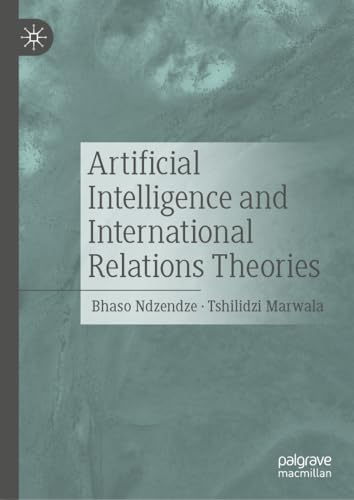
The central intellectual contribution of the book lies in its systematic examination of how AI interacts with established theoretical traditions, including realism, liberalism, hegemonic stability theory, dependency theory, the English School, constructivism, postcolonialism, feminism, and green theory. Rather than treating AI exclusively as a technological innovation or an instrument of state power, the authors situate it within broader debates concerning international order, inequality, conflict, and cooperation. Their interdisciplinary approach challenges scholars to reconsider whether conventional theoretical frameworks remain adequate for explaining international politics in an increasingly algorithmic world.

This review argues that the book’s principal strength is its theoretical pluralism and its incorporation of technological transformation into mainstream IR debates. Nevertheless, its broad analytical scope raises important questions concerning theoretical integration, technological agency, methodological consistency, and the political consequences of unequal access to AI. The book is therefore most valuable as a foundation for further theoretical development rather than as a definitive explanation of AI-driven international change.

Theoretical Contributions and Intellectual Framework

The book comprises ten chapters, progressing from conceptual discussions of IR theory and artificial intelligence to examinations of individual theoretical traditions. Its organization provides readers with a structured intellectual framework through which to assess the relationship between emerging technologies and established concepts of international politics.

An important conceptual achievement is the recognition that AI should not simply be interpreted as another technological instrument available to states. Its significance also derives from its potential to transform the processes through which political actors acquire information, evaluate strategic options, and exercise authority. This distinction is crucial because conventional IR theories generally assume that political decisions are made by human actors operating within identifiable institutional and strategic environments.

AI complicates these assumptions by introducing algorithmically mediated intelligence, automated decision systems, and new forms of technological dependence. The resulting challenge is not necessarily that traditional theories become obsolete, but that their explanatory variables may require substantial reconsideration.

The authors’ combination of conventional and critical approaches also constitutes a welcome departure from technologically deterministic interpretations of international politics. Realism foregrounds competition and security, whereas liberalism emphasizes institutions and cooperation. Dependency theory draws attention to structural inequalities, while constructivist and other critical perspectives provide opportunities to examine norms, identities, and asymmetrical relationships of technological authority.

Nevertheless, theoretical diversity does not automatically produce theoretical synthesis. A more integrated conceptual model linking technological capabilities, institutional arrangements, political agency, and international outcomes would strengthen the explanatory coherence of the framework. Without such integration, the analysis risks becoming a collection of parallel theoretical interpretations rather than a unified account of technological transformation.

Realism, Strategic Competition, and Artificial Intelligence

The realist perspective constitutes one of the book’s most significant contributions because AI increasingly occupies a central position in strategic competition among major powers. Chapter Four examines realism through its philosophical foundations, including Thomas Hobbes, and connects technological innovation to enduring questions of anarchy, national security, and state power.

From a realist perspective, AI can be understood as a strategic resource capable of enhancing military effectiveness, intelligence collection, surveillance, cyber capabilities, and decision-making. Competition between the United States and China illustrates how technological leadership has become intertwined with national security and geopolitical influence.

AI also presents challenges to established understandings of deterrence and strategic stability. Autonomous systems, algorithmic targeting, and accelerated intelligence assessments could reduce decision-making time during international crises. These developments potentially increase uncertainty, particularly when governments cannot adequately interpret adversaries’ technological capabilities or intentions.

The book’s engagement with realism is therefore especially relevant to contemporary security studies. Yet an important theoretical distinction deserves greater attention: technological superiority does not necessarily translate into political influence or strategic success. States require organizational capacity, institutional coordination, reliable infrastructure, and effective military doctrines to convert technological advantages into geopolitical outcomes.

Neoclassical realism could usefully complement the analysis by explaining how domestic institutions and leadership perceptions mediate the relationship between AI capabilities and foreign policy behavior. Such an approach would provide a more differentiated account of why states possessing comparable technological resources may pursue contrasting international strategies.

Liberalism, Institutions, and Global AI Governance

The book’s treatment of liberalism offers an alternative perspective by examining the relationship between technological development, international cooperation, and institutional arrangements. AI can facilitate cross-border economic exchange, scientific collaboration, public administration, and international communication. These possibilities reinforce liberal assumptions that interdependence and institutional cooperation can generate mutual benefits.

However, AI also produces regulatory dilemmas that challenge liberal expectations. Divergent national approaches to data governance, cybersecurity, algorithmic accountability, and technological sovereignty create potential tensions between economic integration and national autonomy.

International institutions therefore confront a fundamental problem: how can governments establish credible governance arrangements for technologies that evolve more rapidly than conventional diplomatic negotiations?

The book’s liberal framework offers a productive starting point for investigating this question. Nevertheless, cooperation should not be assumed to emerge automatically from technological interdependence. Differences in economic capacity, technological ownership, regulatory preferences, and strategic interests can obstruct collective governance.

An expanded engagement with regime complexity and international institutional design would strengthen the analysis. AI governance increasingly involves overlapping national regulations, multilateral initiatives, industry standards, and private-sector arrangements. Consequently, liberal institutionalism must explain not only the prospects for cooperation but also the fragmentation and contestation of emerging technological governance regimes.

Hegemonic Stability, Dependency, and Technological Inequality

Particularly valuable are the chapters addressing hegemonic stability theory and technological dependency. These perspectives illuminate the structural consequences of technological concentration within the international system.

The discussion of hegemonic stability theory situates AI within debates about leadership, great-power competition, and changes in the distribution of capabilities. Its engagement with China’s technological advancement, including the symbolic significance of AlphaGo, illustrates how AI has entered discussions about international hierarchy and potential shifts in global leadership.

Springer Nature Link

Nevertheless, technological leadership should not be equated with hegemony. The ability to develop advanced algorithms differs from the capacity to establish international rules, provide collective goods, or secure widespread political legitimacy. A comprehensive theory of AI hegemony must therefore distinguish technological dominance from institutional leadership and normative authority.

The dependency perspective offers an especially important contribution for understanding the Global South. AI development depends on access to computational infrastructure, advanced semiconductors, reliable energy, specialized human capital, large datasets, and financial investment. Their unequal international distribution creates the possibility of new dependency relationships between technologically advanced economies and developing countries.

This argument carries important implications for countries such as Indonesia, South Africa, India, and other emerging economies pursuing digital industrialization and technological sovereignty.

However, dependency should be understood as a multidimensional relationship rather than a predetermined condition. Developing countries may exercise agency through industrial policy, regional cooperation, technology partnerships, educational investment, and regulatory innovation. Integrating these possibilities would help explain how technological dependency can be reproduced, negotiated, or partially overcome.

Critical Perspectives and the Politics of Technological Power

Another important strength of the book is its inclusion of constructivism, postcolonialism, feminism, and green theory within its examination of AI. Chapter Nine explicitly brings these perspectives together, thereby broadening the discussion beyond conventional questions of military security and economic competition.

Constructivism offers analytical tools for examining how ideas, identities, norms, and discourses shape the international development and governance of AI. Political narratives surrounding technological leadership, digital sovereignty, and responsible innovation can influence state behavior independently of material technological capacity.

Postcolonial perspectives are equally significant because technological development occurs within historically unequal international structures. The concentration of computing infrastructure, intellectual property, data resources, and commercial platforms may reproduce existing inequalities while creating new forms of technological domination.

Feminist approaches encourage scholars to examine algorithmic discrimination, unequal participation in technological development, and the gendered consequences of digital governance. Green theory draws attention to the environmental dimensions of AI, particularly the energy requirements of computing infrastructure and the resource-intensive production of advanced technologies.

These critical perspectives significantly enrich the book’s intellectual agenda. However, placing several complex theoretical traditions within one relatively brief chapter necessarily limits the depth available to each. More extensive treatment would allow the authors to explore the distinctive causal assumptions and normative commitments of these approaches.

Importantly, critical theories should not be treated merely as supplementary ethical perspectives. They can also generate substantive explanations of international technological hierarchies, institutional exclusion, and the political construction of technological authority.

Methodological Strengths and Limitations

The authors’ stated reliance on original datasets, empirical case studies, and engagement with established theoretical propositions represents an important attempt to connect conceptual inquiry with observable international developments. The publisher explicitly identifies this empirical orientation as a defining characteristic of the book.

Nevertheless, assessing AI’s consequences for international politics presents formidable methodological challenges. AI is not a single, homogeneous technology. Machine learning, autonomous weapons systems, generative models, facial recognition, and predictive analytics possess different political applications and institutional implications.

Consequently, general propositions about AI and international relations require careful specification of technological characteristics, units of analysis, and causal mechanisms.

A further difficulty concerns the speed of technological change. The emergence and rapid diffusion of generative AI after the book’s publication have intensified debates about misinformation, diplomatic communication, cognitive security, and algorithmic influence.

These developments do not invalidate the authors’ arguments. Rather, they demonstrate the need for continuously updated empirical research capable of distinguishing enduring theoretical relationships from technology-specific developments.

Future scholarship could extend the book’s framework through comparative case studies, process tracing, institutional analysis, and longitudinal examinations of national AI strategies. Such methods would allow researchers to assess more systematically whether technological transformation changes the distribution of power, the behavior of international actors, or the underlying structure of the international system.

Relevance for the Global South and Future Research

One of the book’s most promising implications concerns the position of developing countries within the emerging technological international order. For Global South states, AI simultaneously presents opportunities for economic modernization and risks of intensified structural dependence.

The book’s theoretical approach can inform research on technological sovereignty, digital diplomacy, South–South cooperation, and strategic autonomy. In Southeast Asia, for example, scholars might examine how ASEAN member states navigate competition between major technology powers while pursuing their own digital transformation objectives.

Indonesia offers a particularly relevant analytical case. Its commitment to an independent and active foreign policy raises questions about how middle powers can preserve strategic flexibility when technological ecosystems are increasingly shaped by competing international actors.

A productive extension of the book would therefore integrate middle-power theory, regionalism, and foreign policy analysis with its existing theoretical perspectives.

Such research would help explain whether AI reinforces established global hierarchies or creates meaningful opportunities for developing states to reshape international technological governance.

Conclusion

Artificial Intelligence and International Relations Theories is a significant and intellectually stimulating contribution to scholarship examining the relationship between technological transformation and international politics. Its greatest achievement lies in demonstrating that AI should be incorporated into the theoretical foundations of international relations rather than confined to specialized discussions of cybersecurity, innovation, or military technology.

The authors successfully establish a broad intellectual agenda encompassing strategic competition, international cooperation, technological inequality, and critical approaches to power. Their interdisciplinary orientation makes the book particularly valuable for scholars and postgraduate students seeking to connect technological developments with established debates in international political theory.

Its principal limitation is the difficulty of achieving analytical integration across numerous theoretical traditions within a relatively concise volume. The framework would benefit from stronger specification of causal mechanisms, a clearer conceptualization of technological agency, and more sustained attention to the political autonomy of developing countries.

Despite these limitations, the book provides an important starting point for rethinking international relations in an era of algorithmic transformation. It is particularly recommended for researchers in international relations theory, international political economy, security studies, and global technology governance. Ultimately, its enduring contribution lies in advancing a fundamental disciplinary question: whether artificial intelligence merely alters the instruments of international politics or transforms the assumptions upon which international relations theories have traditionally been constructed.

Share this:

  • Share on X (Opens in new window) X
  • Share on Facebook (Opens in new window) Facebook
  • Share on WhatsApp (Opens in new window) WhatsApp
  • Share on LinkedIn (Opens in new window) LinkedIn
  • Email a link to a friend (Opens in new window) Email
  • Print (Opens in new window) Print
Like Loading...

Beyond Managed Competition: The Xi Jinping–Donald Trump Summit and Its Implications for the Architecture of Global Politics

14 Thursday May 2026

Posted by Setiawan in Global Politics, Hubungan Internasional, International Relations, Journal Article

≈ Leave a comment

Tags

china, economy, International relations, news, Summit, trump

Abstract

The May 2026 Beijing Summit between Chinese President Xi Jinping and United States President Donald Trump represents a watershed moment in twenty-first-century global politics, occurring at a juncture where the international order is simultaneously challenged by great-power rivalry, regional conflict, and structural economic uncertainty. This article examines the geopolitical significance of the Xi–Trump summits — specifically the October 2025 Busan meeting and the May 2026 Beijing summit — arguing that these diplomatic encounters reveal not a return to cooperative bipolarity, but rather the institutionalisation of a new form of structured rivalry with managed dialogue, wherein competition and selective engagement coexist as parallel logics of statecraft. Drawing on neorealist, liberal institutionalist, and hegemonic stability theoretical frameworks, and employing qualitative content analysis of summit communiqués, policy documents, and secondary scholarly sources, this article finds that: (1) the summits failed to resolve core structural tensions over Taiwan, technology supremacy, and military expansion; (2) they produced temporary economic accommodations — notably a tariff truce and rare-earth supply agreement — that stabilise markets without addressing root causes; and (3) the summits signal a broader reorientation of the international order toward conditional multipolarity, in which middle and secondary powers are compelled to navigate between the two competing poles. The research contributes to the emerging literature on summit diplomacy in the context of hegemonic transition and offers a novel analytical lens — competitive engagement equilibrium — to theorise US–China diplomatic interactions. The findings carry significant implications for global governance, Indo-Pacific regional security, and the future of multilateral institutions.

Keywords: Xi Jinping–Trump Summit; US–China Relations; Great Power Competition; Global Order; Summit Diplomacy; Hegemonic Transition; Competitive Engagement Equilibrium

Introduction

The encounter between the two most powerful leaders in the contemporary international system invariably carries consequences that transcend their respective bilateral relationship. When United States President Donald Trump arrived in Beijing on 14 May 2026 for a state summit with Chinese President Xi Jinping, the meeting crystallised months of diplomatic manoeuvring, economic brinkmanship, and geopolitical recalculation (Al Jazeera, 2026a). The summit followed a precedent-setting meeting in Busan, South Korea, in October 2025, where the two leaders agreed to a one-year tariff truce, secured a rare-earth supply agreement, and signalled a shared — if fragile — interest in bilateral stability (Edelman Global Advisory, 2025). Together, these summits constitute the most consequential diplomatic episodes in the US–China relationship since the post-Cold War period and demand rigorous scholarly scrutiny.

The structural backdrop is one of intensifying systemic tension. Chinese exports surged by more than 14% in April 2026 even as the Trump administration maintained broad tariff pressure, complicating Washington’s strategic leverage (Jerusalem Post, 2026). Meanwhile, the ongoing Iran conflict, which had blockaded the Strait of Hormuz — a corridor through which over 30% of China’s oil supply flows — cast an unprecedented shadow over both powers’ strategic calculations (New York Times, 2026). The Strait of Malacca, through which approximately 40% of global trade passes and which China regards as a strategic lifeline, became a focal point of US–Indonesia defence cooperation discussions, raising Beijing’s anxieties about maritime chokepoint vulnerability (Jerusalem Post, 2026). Taiwan remained a deeply contested issue, with China seeking assurances from Trump against US support for Taiwanese independence while Washington maintained ambiguity as a strategic instrument (Al Jazeera, 2026b). Technology competition — particularly around semiconductors, artificial intelligence, and critical minerals — further structured the agenda of both summits (Atlantic Council, 2026).

Scholars of international relations have long recognised that direct leader-to-leader diplomacy serves functions beyond formal agreement-making, including the management of misperceptions, the signalling of red lines, and the performance of relative power (Allison, 2017; Mearsheimer, 2001). Yet the particular configuration of the 2025–2026 Xi–Trump summits — characterised by diminished US leverage, a distracted superpower entangled in the Iran war, and a China pursuing strategic patience — raises novel questions about the directionality of hegemonic transition and the future architecture of global order (New York Times, 2026; Council on Foreign Relations, 2026a).

 The question to answer is to  what extent do the Xi Jinping–Donald Trump summits of 2025–2026 reflect and accelerate a structural transformation in the architecture of global politics, and what theoretical frameworks best illuminate their significance? Aims of the article is  analyse the geopolitical significance of the Xi–Trump summits within the context of US–China strategic competition and the broader dynamics of hegemonic transition in the international system. And to develop a novel theoretical concept — competitive engagement equilibrium — that captures the coexistence of rivalry and selective cooperation as a defining logic of contemporary great-power summit diplomacy.

The academic literature on US–China relations and summit diplomacy provides an indispensable foundation for the analysis developed in this article. Five recent scholarly contributions merit particular attention.

First, Allison’s (2017) foundational work on the Thucydides Trap — the structural tendency toward war when a rising power threatens to displace an established hegemon — remains centrally relevant to the summit dynamics under examination. Allison (2017) argues that of sixteen historical cases in which a rising power challenged a ruling one, twelve resulted in armed conflict. While the Xi–Trump summits represent a deliberate effort to prevent such an outcome, the structural pressures Allison (2017) identifies — particularly over Taiwan, technology leadership, and naval supremacy — were visibly operative in both the Busan and Beijing meetings.

Second, Ikenberry (2011, 2023) advances a liberal institutionalist argument that the United States-led rules-based international order, though challenged, retains resilience through institutional stickiness and normative appeal. His more recent work acknowledges, however, that Trump’s transactionalism and unilateralism have eroded the institutional foundations of this order, creating a governance vacuum that China is actively seeking to fill through its own multilateral initiatives such as the Belt and Road Initiative and the Global Development Initiative (Ikenberry, 2023). The summits, in this reading, represent a contest not merely over trade balances but over the institutional DNA of the emerging global order.

Third, Yan (2019) and his concept of moral realism — developed within the Tsinghua school of international relations — offers a distinctly Chinese analytical perspective. Yan (2019) argues that China’s foreign policy under Xi Jinping is guided by a strategic calculus that emphasises national capability consolidation, multilateral normative leadership, and the long-term delegitimisation of US-led unipolarity. The October 2025 Busan Summit, in which Xi successfully positioned China as a constructive global actor committed to trade stability and conflict resolution in Ukraine, reflects elements of this moral realist strategy (ABC News, 2025).

Fourth, Nye (2011, 2024) emphasises the continuing importance of soft power and institutional legitimacy in determining long-run international influence. His framework is illuminating in light of China’s demonstrably superior diplomatic positioning in the 2026 Beijing Summit. As Reuters (2026) documented in an eight-chart analysis, Trump arrived in Beijing with slumping domestic approval ratings and diminished strategic leverage following the inconclusive Iran conflict, while Xi appeared both domestically consolidated and internationally assertive. Nye’s (2011, 2024) logic suggests that the soft-power asymmetry between the two leaders structurally shaped the summit’s limited outcomes.

Fifth, Christensen (2021, 2023) argues against both decoupling pessimism and naïve engagement optimism, advocating instead for a strategy of “clear-eyed competition” in which the United States maintains firm positions on core national interests while preserving communication channels to prevent miscalculation. His framework resonates strongly with the actual dynamics of both summits, which achieved modest and time-bound accommodations — notably the tariff truce and rare-earth agreement — precisely because both sides understood that their structural competition was irresolvable in a single diplomatic encounter (CSIS, 2026; Edelman Global Advisory, 2025).

While existing scholarship has examined specific dimensions of US–China relations — including trade conflict (Kroeber, 2020), technology competition (South China Morning Post, 2026), and soft power rivalry (Nye, 2024) — no prior study has systematically theorised the 2025–2026 Xi–Trump summits as a diagnostic lens for hegemonic transition in a multi-crisis international environment. Critically, the Iran war variable — absent from all pre-2026 analyses — substantially altered both the power asymmetry between the two leaders and the scope of achievable outcomes at the Beijing Summit. This article introduces the concept of competitive engagement equilibrium as an original analytical contribution: a conceptual tool that moves beyond both “managed competition” (Christensen, 2021) and “strategic rivalry” (Mearsheimer, 2001) to theorise diplomatic encounters in which both powers simultaneously compete and cooperate across different issue areas, with neither logic fully dominating the relationship. This represents a distinct advance on existing frameworks.

Results and Discussion

Summit Diplomacy as Structural Signalling

At the most fundamental level, the Xi–Trump summits of 2025–2026 must be understood not merely as bilateral negotiations but as structural signals addressed to the entire international system. When Trump arrived at the Great Hall of the People on 14 May 2026 — greeted by a ceremonial guard and a choreographed display of diplomatic formality — the symbolic register of the encounter communicated as much as any formal agreement (Al Jazeera, 2026a). Xi’s statement that the shared interests between China and the United States “surpass their disagreements” was not merely a diplomatic courtesy; it was a strategic narrative addressed to the Global South, to US allies in Europe and Asia, and to domestic audiences in both countries (Financial Times, 2026).

The structural significance of summit-level diplomacy in contemporary international relations theory has been well established. Gilpin (1981) argued that systemic change — the transition from one hegemonic order to another — is ultimately a political process, shaped by the decisions of leading states and their ability to manage the distribution of power. The Xi–Trump summits occur at precisely such an inflection point. The unipolar moment of the 1990s has given way to a more complex structural environment in which, as the Fletcher Forum (2026) documented, the Global South is rising, the Western alliance is fractured, and the path ahead for the liberal international order is deeply uncertain. Within this environment, the personal summit between the leaders of the world’s two largest economies functions as a kind of geopolitical barometer, signalling to other states how they should calibrate their alignments and hedging strategies.

The Busan Summit of October 2025 is instructive in this regard. The agreement to reduce tariffs on Chinese imports from 57% to 47%, the resumption of US soybean purchases, and the rare-earth supply deal were, in themselves, modest economic accommodations (ABC News, 2025). Yet their geopolitical significance was disproportionately large: by demonstrating that the two powers could reach pragmatic agreements even in a context of deep structural rivalry, the summit reduced systemic uncertainty for markets, investors, and allied governments worldwide (Edelman Global Advisory, 2025). This is what hegemonic stability theory (Kindleberger, 1973; Gilpin, 1987) predicts: even competing great powers have a shared interest in maintaining some degree of systemic order, because the costs of complete breakdown — financial contagion, supply chain disruption, regional conflicts — fall on both.

The Iran Variable and the Shifting Power Asymmetry

Perhaps the most analytically important — and underappreciated — aspect of the 2026 Beijing Summit is the degree to which the ongoing US war against Iran had structurally weakened Trump’s negotiating position before talks even began. As the New York Times (2026) documented, Trump had originally planned the Beijing visit on the assumption that Iran would have capitulated to US demands by the time he arrived — thus projecting an image of American strength. Instead, Iran’s nuclear stockpile remained intact, the Strait of Hormuz remained blocked, and Trump arrived carrying the reputational damage of being described by German Chancellor Friedrich Merz as “humiliated” by a weaker adversary.

For China, the Iran conflict created a double-edged strategic environment. On one hand, Beijing was itself economically damaged by the Hormuz blockade, which disrupted over 30% of its oil and natural gas supplies (New York Times, 2026). On the other hand, Washington’s entanglement in a costly Middle Eastern conflict reduced its bandwidth and credibility for Indo-Pacific competition, tilting the relative power balance — at least temporarily — in Beijing’s favour. Reuters’ (2026) analysis of eight structural indicators ahead of the summit confirmed that Trump’s domestic approval ratings had slumped and his international leverage had diminished, while Xi presented a consolidated and patient posture.

This asymmetry is theoretically significant. Classic realist analysis (Waltz, 1979; Mearsheimer, 2001) predicts that states exploit moments of relative superiority to extract concessions. Yet what is striking about the 2026 Beijing Summit is the degree to which China did not press its advantage aggressively. Xi’s restrained and constructive tone — his declaration that “there are no winners in a trade war” (Financial Times, 2026) — reflects Yan’s (2019) moral realist insight: China under Xi calculates that demonstrating normative responsibility and strategic patience serves its long-term hegemonic ambitions more effectively than short-term coercive maximalism. In other words, China’s competitive strategy is partly discursive — a sustained effort to delegitimise US unipolarity while positioning Beijing as the more reliable and constructive great power.

Economic Architecture: Trade Truces and Their Structural Limits

The most concrete outcomes of both the Busan and Beijing summits were in the economic domain — and yet even these outcomes must be interpreted with appropriate analytical caution. The one-year tariff truce agreed in Busan, the rare-earth supply agreement, and the resumed US agricultural exports provided genuine short-term relief to markets and businesses facing intense supply-chain uncertainty (Edelman Global Advisory, 2025). The Beijing summit was expected to extend and deepen these accommodations, with Xi likely agreeing to increased purchases of US agricultural products and Boeing aircraft (Al Jazeera, 2026b).

However, as Politico (2026) incisively noted, the summit’s economic agenda was conspicuously silent on the core structural disputes that underpin the bilateral trade conflict: China’s state subsidies to strategic industries, its mercantilist export strategies, and the dramatic asymmetry between the two economies’ technological self-sufficiency trajectories. This is not coincidental. The competitive engagement equilibrium that characterises the Xi–Trump relationship is precisely one in which both sides are willing to negotiate at the margins — adjusting tariffs, managing supply chains, exchanging agricultural goods for political symbolism — while preserving the deeper structures of their rivalry intact. Christensen (2023) identifies this pattern as a form of “competitive coexistence,” in which the shared interest in avoiding catastrophic decoupling creates a functional floor beneath the relationship even as structural competition continues across military, technological, and normative dimensions.

The role of technology competition deserves particular emphasis. The South China Morning Post’s (2026) analysis documented an intensifying race for deep-sea mineral dominance and undersea military capabilities that both preceded and continued through the summits. The US congressional advisory panel’s warning about PLA naval advances — particularly in submarine modernisation and deep-sea resource extraction — highlights that the competition between the two powers operates at multiple technological registers simultaneously. The summits’ relative silence on these issues is itself analytically significant: it reflects both the intractability of the underlying technological competition and the shared recognition that raising such issues explicitly might collapse the diplomatic space for any agreement at all.

Taiwan: The Unspoken Structuring Issue

Taiwan constituted the most explosive and carefully managed dimension of both summits. In the October 2025 Busan meeting, Trump claimed that Taiwan “never came up” in their discussions — a claim that strains analytical credulity given the CCP’s approaching centenary in 2027 and Beijing’s intensifying assertiveness toward the island (The Guardian, 2025). At the Beijing summit, Xi was expected to press Trump for a statement indicating that the United States neither supports nor would defend Taiwan in the event of a declaration of independence, and to seek reductions in US arms sales to Taipei (Jerusalem Post, 2026).

The Taiwan question illustrates with particular clarity the limits of summit diplomacy in resolving deep structural disagreements. For Beijing, Taiwan represents what Christensen (2021) terms a “core interest” — a matter on which no substantive compromise is possible without threatening regime legitimacy. For Washington, maintaining strategic ambiguity on Taiwan’s defence status is itself a deliberate strategic instrument, designed to deter both Chinese military action and unilateral Taiwanese independence declarations (Stanford FSI/APARC, 2026). The summit therefore produced, as Thornton (2026, as cited in Stanford FSI/APARC, 2026) argued ahead of the Beijing meeting, a carefully choreographed performance of mutual acknowledgement rather than substantive agreement — with both sides publicly emphasising shared interests while privately maintaining incompatible positions.

This performative dimension of summit diplomacy has been theorised by social constructivist scholars (Wendt, 1999; Barnett & Finnemore, 2004) as constitutive: the act of summitry itself constructs and reproduces the identities and relationships of the participating states. When Xi and Trump engage in a state visit replete with ceremonial guards, formal banquets, and jointly authored declarations of “shared interests,” they are not merely managing an existing relationship — they are actively constructing a particular narrative about that relationship for domestic and international audiences. The narrative of competitive but engaged great powers, willing to communicate and cooperate at the margins, serves the strategic interests of both governments: it reassures nervous markets, signals to allies and adversaries that catastrophic conflict is not imminent, and preserves the political space for continued competition below the threshold of open confrontation.

Implications for Global Order: Conditional Multipolarity

The broader systemic significance of the Xi–Trump summits lies in their implications for the structure of global politics. The summits are occurring within a world that the Fletcher Forum (2026) characterised as one of “a rising South, a fractured West, and an uncertain path ahead.” Middle and secondary powers — including Indonesia, India, Brazil, and the nations of the ASEAN region — are increasingly compelled to navigate between the two competing poles, a dynamic that resembles what Bull (1977) termed a “neo-medieval” international order, in which sovereignty is formally maintained but practical autonomy is constrained by overlapping power hierarchies.

For the Indo-Pacific specifically, the 2025–2026 summits carry particularly significant implications. The US–Indonesia Major Defense Cooperation Partnership — which grants Washington broader military access to Indonesian airspace and enhanced surveillance over the Strait of Malacca — directly intersects with Chinese fears about maritime chokepoint vulnerability (Jerusalem Post, 2026). China’s response has been to deepen its own multilateral engagements, expanding the Belt and Road Initiative, promoting the Global Development Initiative, and positioning itself as the champion of Global South development aspirations (Zhang & Liu, 2025). This contest between competing visions of multilateral order — one anchored in the US-led liberal institutional framework, the other in China’s inclusive multilateralism — is what Ikenberry (2023) identifies as the central axis of twenty-first-century world politics.

The concept of competitive engagement equilibrium developed in this article captures this structural dynamic. Unlike “managed competition” — which implies a stable, institutionalised framework for containing rivalry — competitive engagement equilibrium theorises a more volatile and contingent condition in which both powers simultaneously compete and cooperate across different issue areas, with no single logic dominating the relationship over time. Trade, technology, and military competition continue unabated even as diplomatic channels are maintained and selective agreements are reached. This equilibrium is inherently unstable — it can be disrupted by sudden shifts in domestic political conditions (as evidenced by Trump’s weakened post-Iran leverage), by regional crises (Taiwan, the Strait of Hormuz), or by technological breakthroughs that decisively shift the balance of capabilities.

Conclusion

The Xi Jinping–Donald Trump summits of 2025–2026 are among the most consequential diplomatic encounters of the contemporary era, and yet their significance lies less in their immediate outcomes than in what they reveal about the structural transformation of global politics. The October 2025 Busan Summit and the May 2026 Beijing Summit demonstrated that the world’s two leading powers retain both the motivation and the diplomatic capacity to reach selective accommodations — on tariffs, rare earths, agricultural trade, and fentanyl enforcement — even as their structural competition across military, technological, and normative dimensions continues and intensifies (Edelman Global Advisory, 2025; ABC News, 2025; Al Jazeera, 2026a).

The article has argued that these summits are best understood through the lens of competitive engagement equilibrium: a structural condition in which rivalry and selective cooperation coexist as parallel logics, with neither logic fully displacing the other. This framework advances the existing theoretical conversation beyond both the pessimism of Thucydides Trap scholarship (Allison, 2017) and the optimism of liberal institutionalism (Ikenberry, 2011, 2023), offering a more nuanced and empirically grounded account of great-power relations in the contemporary era. The Iran war variable — which structurally weakened US leverage and elevated China’s relative strategic patience — introduced a novel and undertheorised dimension into the bilateral relationship, demonstrating that third-party crises can fundamentally reshape the power asymmetries of great-power summitry in ways that existing frameworks (Waltz, 1979; Mearsheimer, 2001) insufficiently anticipate.

The implications for global order are profound. The world is moving toward what this article terms conditional multipolarity: a structural condition in which multiple power centres coexist, but the actions of the two leading states continue to structure the choices and alignments of all others. Middle powers in the Indo-Pacific and the Global South face intensified pressure to hedge, diversify, and strategically position themselves between the two poles (Bull, 1977; Kindleberger, 1973). Multilateral institutions face increasing legitimacy contests between competing normative frameworks (Ikenberry, 2023; Zhang & Liu, 2025). The architecture of global politics, in short, is being rewritten — and the Xi–Trump summits are both its most vivid symptom and one of its most active causes.

References

ABC News. (2025, October 30). Key takeaways from October Trump and Xi meeting. https://www.abc.net.au/news/2025-10-30/key-takeaways-from-october-trump-and-xi-meeting/105952166

Al Jazeera. (2025, January 17). Trump speaks with China’s Xi, says leaders will make world ‘more peaceful’. https://www.aljazeera.com/news/2025/1/17/trump-speaks-with-chinas-xi-says-leaders-will-make-world-more-peaceful

Al Jazeera. (2026a, May 14). Trump hails Xi as a ‘great leader’ as talks on trade, tech held in Beijing. https://www.aljazeera.com/news/liveblog/2026/5/14/trump-xi-summit-live

Al Jazeera. (2026b, May 13). China’s Xi expected to press Trump on Taiwan, tariffs during summit. https://www.aljazeera.com/news/2026/5/13/chinas-xi-to-press-trump-on-taiwan-tariffs-during-summit

Allison, G. (2017). Destined for war: Can America and China escape Thucydides’s trap? Houghton Mifflin Harcourt.

Atlantic Council. (2026, May 10). Five outcomes that would make Trump’s trip to China a success. https://www.atlanticcouncil.org/dispatches/five-outcomes-that-would-make-trumps-trip-to-china-a-success/

Barnett, M., & Finnemore, M. (2004). Rules for the world: International organizations in global politics. Cornell University Press.

Bull, H. (1977). The anarchical society: A study of order in world politics. Columbia University Press.

Christensen, T. J. (2021). A modern tragedy? COVID-19 and US–China relations. Brookings Institution Press.

Christensen, T. J. (2023). The China challenge: Shaping the choices of a rising power. Foreign Affairs, 102(3), 18–35.

Council on Foreign Relations. (2026a, May 10). Trump–Xi summit: Analysis and updates. https://www.cfr.org/trump-xi-summit-analysis-and-updates

Council on Foreign Relations. (2026b, May 9). At the Trump–Xi summit, China will have the upper hand. https://www.cfr.org/articles/at-the-trump-xi-summit-china-will-have-the-upper-hand

CSIS. (2026, May 7). Trump–Xi summit in Beijing: Managing the world’s most important relationship. https://www.csis.org/analysis/trump-xi-summit-beijing-managing-worlds-most-important-relationship

Edelman Global Advisory. (2025, November 3). Xi–Trump summit delivers a one-year time-out. https://www.edelmanglobaladvisory.com/insights/china-us-relationship-xi-trump-summit-delivers-one-year-time-out

Financial Times. (2026, May 14). What Xi Jinping and Donald Trump want from their Beijing summit. https://www.ft.com/content/c3938efb

Fletcher Forum. (2026). Which way the world order? A rising South, a fractured West, and the path ahead. Fletcher School, Tufts University. https://www.fletcherforum.org/s/7-Winter-2026-Which-Way-the-World-Order-A-Rising-South-a-Fractured-West-and-the-Path-Ahead.pdf

Gilpin, R. (1981). War and change in world politics. Cambridge University Press.

Gilpin, R. (1987). The political economy of international relations. Princeton University Press.

The Guardian. (2025, October 30). Five key takeaways from Donald Trump’s meeting with Xi Jinping. https://www.theguardian.com/us-news/2025/oct/30/five-key-takeaways-donald-trump-meeting-xi-jinping-china-us-trade-talks

Ikenberry, G. J. (2011). Liberal leviathan: The origins, crisis, and transformation of the American world order. Princeton University Press.

Ikenberry, G. J. (2023). The end of liberal international order? International Affairs, 99(1), 65–82.

Jerusalem Post. (2026, May 11). US–China summit tests ties as tensions grow over Taiwan. https://www.jpost.com/international/article-895884

Kindleberger, C. (1973). The world in depression, 1929–1939. University of California Press.

Kroeber, A. (2020). China’s economy: What everyone needs to know. Oxford University Press.

Mearsheimer, J. J. (2001). The tragedy of great power politics. Norton.

New York Times. (2026, May 12). Distracted and bogged down, Trump and Xi enter a summit of reduced ambitions. https://www.nytimes.com/2026/05/12/us/politics/trump-xi-summit.html

Nye, J. S. (2011). The future of power. PublicAffairs.

Nye, J. S. (2024). Soft power in a changing world. Harvard Kennedy School Policy Brief.

Politico. (2026, May 13). How the Trump–Xi meeting became ‘the shrinking summit’. https://www.politico.com/news/2026/05/13/trump-summit-xi-trade-hormuz-00915983

Reuters. (2026, May 13). How Trump’s hand weakened ahead of Xi summit, in eight charts. https://www.reuters.com/commentary/reuters-open-interest/how-trumps-hand-has-weakened-ahead-xi-summit-8-charts-2026-05-13/

South China Morning Post. (2026, May 8). Latest US–China rivalry combines undersea dominance with a race to riches. https://www.scmp.com/news/china/diplomacy/article/3352917

Stanford FSI/APARC. (2026, May 11). The stakes of the Trump–Xi summit and what’s next for US–China relations. https://fsi.stanford.edu/news/stakes-trump-xi-summit-and-whats-next-us-china-relations

Waltz, K. N. (1979). Theory of international politics. Addison-Wesley.

Wendt, A. (1999). Social theory of international politics. Cambridge University Press.

Yan, X. (2019). Leadership and the rise of great powers. Princeton University Press.

Zhang, J., & Liu, M. (2025). A comparative analysis of China’s new era economic diplomacy and the economic diplomacy strategy of the Biden administration. Journal of Modern Social Sciences, 2(2), 126–131. https://doi.org/10.71113/JMSS.v2i2.257

Share this:

  • Share on X (Opens in new window) X
  • Share on Facebook (Opens in new window) Facebook
  • Share on WhatsApp (Opens in new window) WhatsApp
  • Share on LinkedIn (Opens in new window) LinkedIn
  • Email a link to a friend (Opens in new window) Email
  • Print (Opens in new window) Print
Like Loading...

Books on International Relations

20 Saturday Feb 2021

Posted by Setiawan in Books, Books, Hubungan Internasional, International Relations

≈ Leave a comment

Tags

Books, hubungan internasional, International relations

Diplomasi Maritim Indonesia

DOWNLOAD BUKU DIPLOMASI MARITIM INDONESIA (2)

DIPLOMASI EKONOMI INDONESIA DI ASIA TENGAH

POLITIK LUAR NEGERI INDONESIA: AKTOR DAN STRUKTUR


DOWNLOAD POLITIK LUAR NEGERI INDONESIA STRUKTUR DAN AKTOR

KATALOG-2021-web_compressed


PENGANTAR STUDI POLITIK LUAR NEGERI INDONESIA

Share this:

  • Share on X (Opens in new window) X
  • Share on Facebook (Opens in new window) Facebook
  • Share on WhatsApp (Opens in new window) WhatsApp
  • Share on LinkedIn (Opens in new window) LinkedIn
  • Email a link to a friend (Opens in new window) Email
  • Print (Opens in new window) Print
Like Loading...

Recent Posts

  • Artificial Intelligence and the Transformation of International Relations Theory: A Critical Review of Ndzendze and Marwala
  • KEMULIAAN HARI ARAFAH: PUNCAK KESEMPURNAAN IBADAH DAN AMPUNAN ILAH
  • ARAFAH: PUNCAK MAHABBAH DAN MAGFIRAH YANG MENGGETARKAN JIWA
  • Beyond Managed Competition: The Xi Jinping–Donald Trump Summit and Its Implications for the Architecture of Global Politics
  • Ketika Nikmat Membuat Lupa:Membaca Ulang Fitrah Manusia dalam Al-Qur’an dan Relevansinya bagi Kehidupan Modern

Archives

Categories

My Tweets

Pages

  • About
  • Academic Profile
  • Bahasa Inggris Diplomasi
  • Karya Jurnalistik
  • My Books
  • NEWSROOM-HLNKI
  • Pengantar Hubungan Internasional
  • Politik Luar Negeri Indonesia
  • RoomHLNKI

Create a website or blog at WordPress.com

  • Subscribe Subscribed
    Jurnal Asep Setiawan

    Have a WordPress.com account? Log in now.

  • Jurnal Asep Setiawan
    View site in Reader
    Manage subscriptionsSign upLog in
    Report this content
    Collapse this bar
Loading Comments...
%d