
Book reviewed: Ndzendze, B., & Marwala, T. (2023). Artificial Intelligence and International Relations Theories. Palgrave Macmillan, Singapore. 165 pp. ISBN: 978-981-19-4876-3 (hardcover); 978-981-19-4877-0 (eBook). https://doi.org/10.1007/978-981-19-4877-0
Introduction
The rapid development of artificial intelligence (AI) has generated profound questions about the changing nature of power, security, cooperation, and governance in international politics. As AI technologies increasingly influence military capabilities, economic competitiveness, diplomatic decision-making, and global communication, established international relations (IR) theories face the challenge of explaining a technological transformation that transcends conventional distinctions between domestic and international politics. Against this background, Bhaso Ndzendze and Tshilidzi Marwala’s Artificial Intelligence and International Relations Theories (2023) represents a timely and ambitious contribution to the growing intersection between technological innovation and international political analysis.
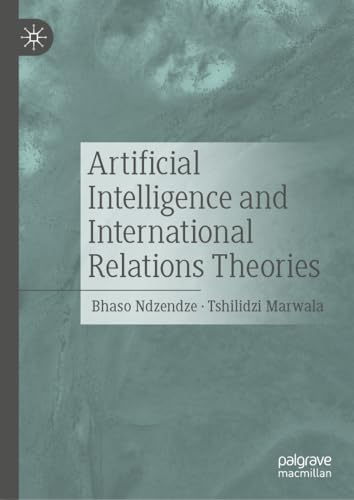
The central intellectual contribution of the book lies in its systematic examination of how AI interacts with established theoretical traditions, including realism, liberalism, hegemonic stability theory, dependency theory, the English School, constructivism, postcolonialism, feminism, and green theory. Rather than treating AI exclusively as a technological innovation or an instrument of state power, the authors situate it within broader debates concerning international order, inequality, conflict, and cooperation. Their interdisciplinary approach challenges scholars to reconsider whether conventional theoretical frameworks remain adequate for explaining international politics in an increasingly algorithmic world.
This review argues that the book’s principal strength is its theoretical pluralism and its incorporation of technological transformation into mainstream IR debates. Nevertheless, its broad analytical scope raises important questions concerning theoretical integration, technological agency, methodological consistency, and the political consequences of unequal access to AI. The book is therefore most valuable as a foundation for further theoretical development rather than as a definitive explanation of AI-driven international change.
Theoretical Contributions and Intellectual Framework
The book comprises ten chapters, progressing from conceptual discussions of IR theory and artificial intelligence to examinations of individual theoretical traditions. Its organization provides readers with a structured intellectual framework through which to assess the relationship between emerging technologies and established concepts of international politics.
An important conceptual achievement is the recognition that AI should not simply be interpreted as another technological instrument available to states. Its significance also derives from its potential to transform the processes through which political actors acquire information, evaluate strategic options, and exercise authority. This distinction is crucial because conventional IR theories generally assume that political decisions are made by human actors operating within identifiable institutional and strategic environments.
AI complicates these assumptions by introducing algorithmically mediated intelligence, automated decision systems, and new forms of technological dependence. The resulting challenge is not necessarily that traditional theories become obsolete, but that their explanatory variables may require substantial reconsideration.
The authors’ combination of conventional and critical approaches also constitutes a welcome departure from technologically deterministic interpretations of international politics. Realism foregrounds competition and security, whereas liberalism emphasizes institutions and cooperation. Dependency theory draws attention to structural inequalities, while constructivist and other critical perspectives provide opportunities to examine norms, identities, and asymmetrical relationships of technological authority.
Nevertheless, theoretical diversity does not automatically produce theoretical synthesis. A more integrated conceptual model linking technological capabilities, institutional arrangements, political agency, and international outcomes would strengthen the explanatory coherence of the framework. Without such integration, the analysis risks becoming a collection of parallel theoretical interpretations rather than a unified account of technological transformation.
Realism, Strategic Competition, and Artificial Intelligence
The realist perspective constitutes one of the book’s most significant contributions because AI increasingly occupies a central position in strategic competition among major powers. Chapter Four examines realism through its philosophical foundations, including Thomas Hobbes, and connects technological innovation to enduring questions of anarchy, national security, and state power.
From a realist perspective, AI can be understood as a strategic resource capable of enhancing military effectiveness, intelligence collection, surveillance, cyber capabilities, and decision-making. Competition between the United States and China illustrates how technological leadership has become intertwined with national security and geopolitical influence.
AI also presents challenges to established understandings of deterrence and strategic stability. Autonomous systems, algorithmic targeting, and accelerated intelligence assessments could reduce decision-making time during international crises. These developments potentially increase uncertainty, particularly when governments cannot adequately interpret adversaries’ technological capabilities or intentions.
The book’s engagement with realism is therefore especially relevant to contemporary security studies. Yet an important theoretical distinction deserves greater attention: technological superiority does not necessarily translate into political influence or strategic success. States require organizational capacity, institutional coordination, reliable infrastructure, and effective military doctrines to convert technological advantages into geopolitical outcomes.
Neoclassical realism could usefully complement the analysis by explaining how domestic institutions and leadership perceptions mediate the relationship between AI capabilities and foreign policy behavior. Such an approach would provide a more differentiated account of why states possessing comparable technological resources may pursue contrasting international strategies.
Liberalism, Institutions, and Global AI Governance
The book’s treatment of liberalism offers an alternative perspective by examining the relationship between technological development, international cooperation, and institutional arrangements. AI can facilitate cross-border economic exchange, scientific collaboration, public administration, and international communication. These possibilities reinforce liberal assumptions that interdependence and institutional cooperation can generate mutual benefits.
However, AI also produces regulatory dilemmas that challenge liberal expectations. Divergent national approaches to data governance, cybersecurity, algorithmic accountability, and technological sovereignty create potential tensions between economic integration and national autonomy.
International institutions therefore confront a fundamental problem: how can governments establish credible governance arrangements for technologies that evolve more rapidly than conventional diplomatic negotiations?
The book’s liberal framework offers a productive starting point for investigating this question. Nevertheless, cooperation should not be assumed to emerge automatically from technological interdependence. Differences in economic capacity, technological ownership, regulatory preferences, and strategic interests can obstruct collective governance.
An expanded engagement with regime complexity and international institutional design would strengthen the analysis. AI governance increasingly involves overlapping national regulations, multilateral initiatives, industry standards, and private-sector arrangements. Consequently, liberal institutionalism must explain not only the prospects for cooperation but also the fragmentation and contestation of emerging technological governance regimes.
Hegemonic Stability, Dependency, and Technological Inequality
Particularly valuable are the chapters addressing hegemonic stability theory and technological dependency. These perspectives illuminate the structural consequences of technological concentration within the international system.
The discussion of hegemonic stability theory situates AI within debates about leadership, great-power competition, and changes in the distribution of capabilities. Its engagement with China’s technological advancement, including the symbolic significance of AlphaGo, illustrates how AI has entered discussions about international hierarchy and potential shifts in global leadership.
Springer Nature Link
Nevertheless, technological leadership should not be equated with hegemony. The ability to develop advanced algorithms differs from the capacity to establish international rules, provide collective goods, or secure widespread political legitimacy. A comprehensive theory of AI hegemony must therefore distinguish technological dominance from institutional leadership and normative authority.
The dependency perspective offers an especially important contribution for understanding the Global South. AI development depends on access to computational infrastructure, advanced semiconductors, reliable energy, specialized human capital, large datasets, and financial investment. Their unequal international distribution creates the possibility of new dependency relationships between technologically advanced economies and developing countries.
This argument carries important implications for countries such as Indonesia, South Africa, India, and other emerging economies pursuing digital industrialization and technological sovereignty.
However, dependency should be understood as a multidimensional relationship rather than a predetermined condition. Developing countries may exercise agency through industrial policy, regional cooperation, technology partnerships, educational investment, and regulatory innovation. Integrating these possibilities would help explain how technological dependency can be reproduced, negotiated, or partially overcome.
Critical Perspectives and the Politics of Technological Power
Another important strength of the book is its inclusion of constructivism, postcolonialism, feminism, and green theory within its examination of AI. Chapter Nine explicitly brings these perspectives together, thereby broadening the discussion beyond conventional questions of military security and economic competition.
Constructivism offers analytical tools for examining how ideas, identities, norms, and discourses shape the international development and governance of AI. Political narratives surrounding technological leadership, digital sovereignty, and responsible innovation can influence state behavior independently of material technological capacity.
Postcolonial perspectives are equally significant because technological development occurs within historically unequal international structures. The concentration of computing infrastructure, intellectual property, data resources, and commercial platforms may reproduce existing inequalities while creating new forms of technological domination.
Feminist approaches encourage scholars to examine algorithmic discrimination, unequal participation in technological development, and the gendered consequences of digital governance. Green theory draws attention to the environmental dimensions of AI, particularly the energy requirements of computing infrastructure and the resource-intensive production of advanced technologies.
These critical perspectives significantly enrich the book’s intellectual agenda. However, placing several complex theoretical traditions within one relatively brief chapter necessarily limits the depth available to each. More extensive treatment would allow the authors to explore the distinctive causal assumptions and normative commitments of these approaches.
Importantly, critical theories should not be treated merely as supplementary ethical perspectives. They can also generate substantive explanations of international technological hierarchies, institutional exclusion, and the political construction of technological authority.
Methodological Strengths and Limitations
The authors’ stated reliance on original datasets, empirical case studies, and engagement with established theoretical propositions represents an important attempt to connect conceptual inquiry with observable international developments. The publisher explicitly identifies this empirical orientation as a defining characteristic of the book.
Nevertheless, assessing AI’s consequences for international politics presents formidable methodological challenges. AI is not a single, homogeneous technology. Machine learning, autonomous weapons systems, generative models, facial recognition, and predictive analytics possess different political applications and institutional implications.
Consequently, general propositions about AI and international relations require careful specification of technological characteristics, units of analysis, and causal mechanisms.
A further difficulty concerns the speed of technological change. The emergence and rapid diffusion of generative AI after the book’s publication have intensified debates about misinformation, diplomatic communication, cognitive security, and algorithmic influence.
These developments do not invalidate the authors’ arguments. Rather, they demonstrate the need for continuously updated empirical research capable of distinguishing enduring theoretical relationships from technology-specific developments.
Future scholarship could extend the book’s framework through comparative case studies, process tracing, institutional analysis, and longitudinal examinations of national AI strategies. Such methods would allow researchers to assess more systematically whether technological transformation changes the distribution of power, the behavior of international actors, or the underlying structure of the international system.
Relevance for the Global South and Future Research
One of the book’s most promising implications concerns the position of developing countries within the emerging technological international order. For Global South states, AI simultaneously presents opportunities for economic modernization and risks of intensified structural dependence.
The book’s theoretical approach can inform research on technological sovereignty, digital diplomacy, South–South cooperation, and strategic autonomy. In Southeast Asia, for example, scholars might examine how ASEAN member states navigate competition between major technology powers while pursuing their own digital transformation objectives.
Indonesia offers a particularly relevant analytical case. Its commitment to an independent and active foreign policy raises questions about how middle powers can preserve strategic flexibility when technological ecosystems are increasingly shaped by competing international actors.
A productive extension of the book would therefore integrate middle-power theory, regionalism, and foreign policy analysis with its existing theoretical perspectives.
Such research would help explain whether AI reinforces established global hierarchies or creates meaningful opportunities for developing states to reshape international technological governance.
Conclusion
Artificial Intelligence and International Relations Theories is a significant and intellectually stimulating contribution to scholarship examining the relationship between technological transformation and international politics. Its greatest achievement lies in demonstrating that AI should be incorporated into the theoretical foundations of international relations rather than confined to specialized discussions of cybersecurity, innovation, or military technology.
The authors successfully establish a broad intellectual agenda encompassing strategic competition, international cooperation, technological inequality, and critical approaches to power. Their interdisciplinary orientation makes the book particularly valuable for scholars and postgraduate students seeking to connect technological developments with established debates in international political theory.
Its principal limitation is the difficulty of achieving analytical integration across numerous theoretical traditions within a relatively concise volume. The framework would benefit from stronger specification of causal mechanisms, a clearer conceptualization of technological agency, and more sustained attention to the political autonomy of developing countries.
Despite these limitations, the book provides an important starting point for rethinking international relations in an era of algorithmic transformation. It is particularly recommended for researchers in international relations theory, international political economy, security studies, and global technology governance. Ultimately, its enduring contribution lies in advancing a fundamental disciplinary question: whether artificial intelligence merely alters the instruments of international politics or transforms the assumptions upon which international relations theories have traditionally been constructed.